The marketing landscape has changed Significantly over the past few years. Businesses are expected to deliver personalized experiences, respond to customer inquiries instantly, and create high-quality content at scale. Meeting these demands manually is becoming increasingly difficult.
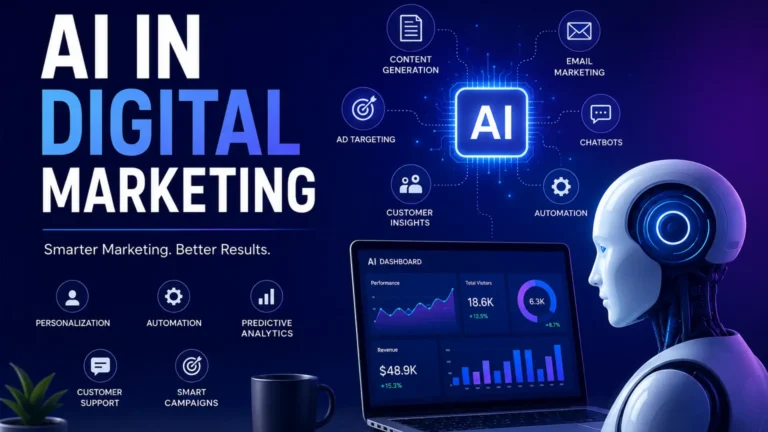
This is where AI in digital marketing is transforming the industry. From content creation and customer segmentation to campaign optimization and predictive analytics, artificial intelligence helps marketers work smarter, faster, and more efficiently.
In 2026, companies that embrace AI-powered marketing solutions gain a significant competitive advantage, while those that ignore them risk falling behind. Whether you’re a startup, eCommerce brand, or established enterprise, understanding how AI can improve your marketing efforts is essential.
What Is AI in Digital Marketing?
AI in digital marketing refers to the use of artificial intelligence technologies to analyze data, automate tasks, improve decision-making, and enhance customer experiences.
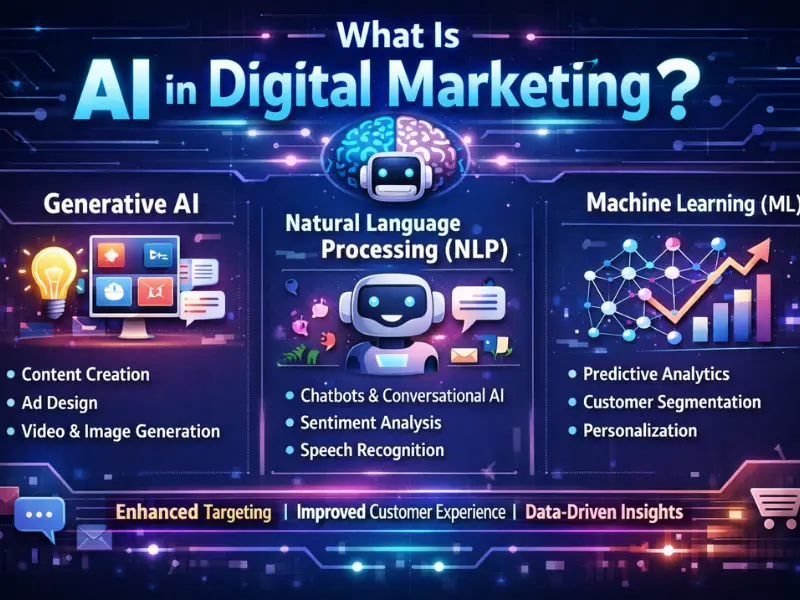
AI works through several technologies:
Machine Learning (ML)
Machine learning enables systems to learn from data and improve performance over time without explicit programming. Marketers use ML to identify patterns, predict customer behavior, and optimize campaigns.
Natural Language Processing (NLP)
NLP allows AI systems to understand and generate human language. It powers chatbots, content generation tools, sentiment analysis, and voice search optimization.
Generative AI
Generative AI creates original content such as blog posts, ad copy, social media captions, images, and videos. This technology helps marketers scale content production while maintaining quality.
Together, these technologies make AI marketing automation more effective and accessible than ever before.
Key Benefits of AI in Digital Marketing
Advanced Personalization
Consumers expect personalized experiences. AI analyzes customer data to deliver relevant product recommendations, tailored content, and customized offers.
Marketing Automation
AI automates repetitive tasks such as email campaigns, audience segmentation, lead scoring, and reporting. This allows marketers to focus on strategy and creativity.
Faster Decision-Making
AI processes large volumes of data in seconds, helping businesses identify trends and opportunities faster than traditional methods.
Cost Reduction
Automation reduces manual workload and improves campaign efficiency, resulting in lower operational costs and higher ROI.
Improved Customer Experience
From personalized messaging to instant support, AI helps brands provide seamless customer experiences across multiple channels.
Top Use Cases of AI in Marketing
AI-Powered Content Creation
Content creation can be time-consuming. AI tools help marketers generate blog outlines, social media content, ad copy, product descriptions, and email campaigns quickly.
While human oversight remains important, AI significantly accelerates content production and ideation.
Predictive Analytics and Customer Behavior
Predictive analytics uses historical data to forecast future customer actions. Businesses can identify high-value leads, predict churn, and improve targeting strategies.
This makes predictive analytics marketing one of the most valuable AI applications today.
Paid Advertising and Smart Bidding
Platforms like Google Ads use AI to optimize bidding strategies automatically. AI analyzes user behavior, conversion likelihood, and market trends to maximize campaign performance.
Email Marketing Automation
AI can determine the best sending times, personalize subject lines, segment audiences, and recommend content based on customer behavior.
These capabilities improve engagement and conversion rates while reducing manual effort.
Chatbots and Customer Support
AI-powered chatbots provide instant responses to customer inquiries 24/7. They improve user experience, reduce support costs, and help businesses capture more leads.
Modern chatbots can answer complex questions and even assist customers throughout the buying journey.
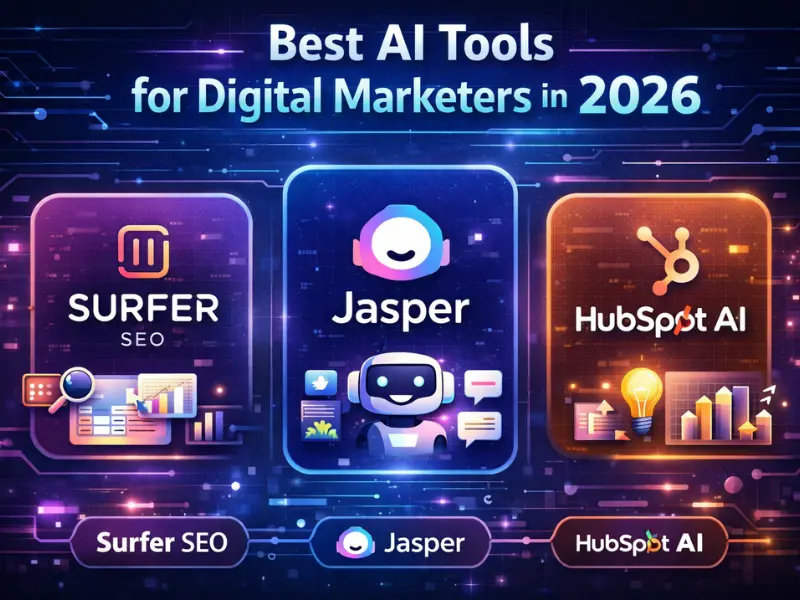
Best AI Tools for Digital Marketers in 2026
HubSpot AI
HubSpot AI helps businesses automate customer relationship management, content creation, lead nurturing, and reporting.
Jasper
Jasper is a leading AI writing platform that assists with blog posts, ad copy, emails, and marketing content.
Surfer SEO
Surfer SEO combines AI with data-driven optimization to help marketers create content that ranks higher in search engines.
Google Performance Max
Google Performance Max uses machine learning to optimize campaigns across Google’s entire advertising ecosystem.
These tools enable businesses to implement AI marketing automation effectively and scale their marketing operations.
How to Build an AI-Powered Marketing Strategy
Define Clear Goals
Identify specific objectives such as increasing leads, improving conversion rates, reducing acquisition costs, or enhancing customer retention.
Audit Existing Marketing Processes
Review your current workflows and identify repetitive tasks that could benefit from AI automation.
Choose the Right AI Tools
Select tools that align with your goals, budget, and team capabilities.
Collect Quality Data
AI systems rely on accurate and relevant data. Ensure your customer data is clean, organized, and compliant with privacy regulations.
Test and Optimize
Start with small experiments, measure results, and continuously refine your AI-driven campaigns.
Maintain Human Oversight
AI should support human decision-making, not replace it. Strategic thinking, creativity, and brand positioning remain human responsibilities.
Common Mistakes to Avoid
Expecting AI to Replace Marketers
AI enhances productivity but cannot fully replace human creativity, emotional intelligence, and strategic planning.
Using Poor-Quality Data
AI outputs are only as good as the data provided. Inaccurate data leads to poor recommendations and ineffective campaigns.
Over-Automating Customer Interactions
Too much automation can make experiences feel impersonal. Balance automation with genuine human engagement.
Ignoring Performance Metrics
Monitor key performance indicators regularly to ensure AI initiatives are delivering measurable results.
The Future of AI-Based Marketing
The future of AI-Based Marketing will be driven by deeper personalization, predictive customer journeys, advanced conversational AI, and real-time optimization.
As AI technology continues to evolve, marketers will gain access to more powerful tools capable of delivering highly relevant experiences across every stage of the customer journey.
Businesses that invest in AI today will be better positioned to adapt to future market changes and customer expectations.
Join Our Community
Join our community on Facebook, and don’t forget to subscribe to us on YouTube for new content each week.
Final Thoughts
Artificial intelligence is no longer a futuristic concept it’s a practical business tool that is reshaping modern marketing. From content creation and customer support to predictive analytics and advertising optimization, AI-Driven Marketing helps businesses improve efficiency, reduce costs, and achieve better results.
Organizations that combine AI technology with human creativity and strategic thinking will be best equipped to succeed in the increasingly competitive digital landscape.
FAQs
1. What is AI in digital marketing?
AI in digital marketing uses artificial intelligence to automate tasks, analyze data, personalize experiences, and improve marketing results.
2. How does AI help marketers?
AI helps marketers create content, optimize ads, automate emails, analyze customer behavior, and improve campaign performance.
3. Can AI improve customer engagement?
Yes. AI personalizes recommendations, messaging, and support, helping businesses deliver more relevant customer experiences.
4. What are the best AI marketing tools in 2026?
Popular AI marketing tools include HubSpot AI, Jasper, Surfer SEO, and Google Performance Max.
5. Will AI replace digital marketers?
No. AI supports marketers by automating repetitive tasks, while human creativity, strategy, and brand voice remain essential.